Do you know that every time two different materials meet in an aircraft, they must be sealed?
Do you also know that aerospace sealants have nothing to do with those used in any other industry?
This is not construction.
This is not automotive.
This is aerospace.
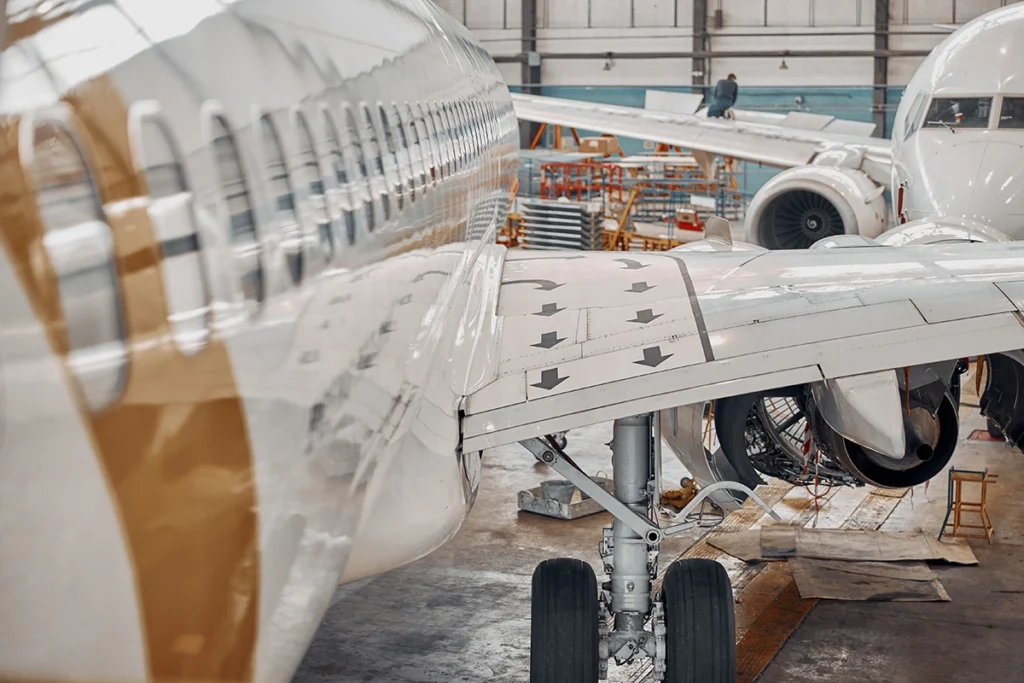
In aviation, sealing is not about filling gaps. It is about ensuring structural integrity, preventing corrosion and guaranteeing airworthiness over decades under extreme conditions.
It’s Not Just the Sealant. It’s the Process.
Polysulfide sealants are remarkable materials.
Products such as Naftoseal MC-780-B2 or PR1776 B-2 reflect the level of engineering behind them. They are designed to resist fuel, mechanical stress, temperature cycles and time itself.
But here is what is often overlooked:
The performance of the sealant depends far more on how it is applied than on the sealant itself.
A Process That Starts Before the Sealant
Sealant application does not begin when you pick up the cartridge. It starts much earlier.
First comes surface preparation.
The area to be sealed must be cleaned following a defined process. Not just visually clean, but prepared in a way that ensures proper adhesion and long-term durability. Any deviation here can compromise everything that follows.
Then comes the application of the promoter.
A thin layer, almost invisible, but absolutely critical. It creates the right conditions for adhesion between the sealant and the substrate. Timing, thickness and environmental conditions all play a role. In reality, this step alone could justify an entire chapter.
Only after that do we move to the sealant itself.
It must be properly mixed to ensure the correct ratio and homogeneity. On paper, you may have up to two hours of working time. In practice, anyone on the shop floor knows that the effective application window is closer to one hour. After that, the material starts to change, becomes harder to work with and the risk of defects increases.
Where Engineering Meets Craftsmanship
This is where things become truly interesting.
Sealant application in aerospace is not just a process. It is a qualified operation carried out by trained professionals.
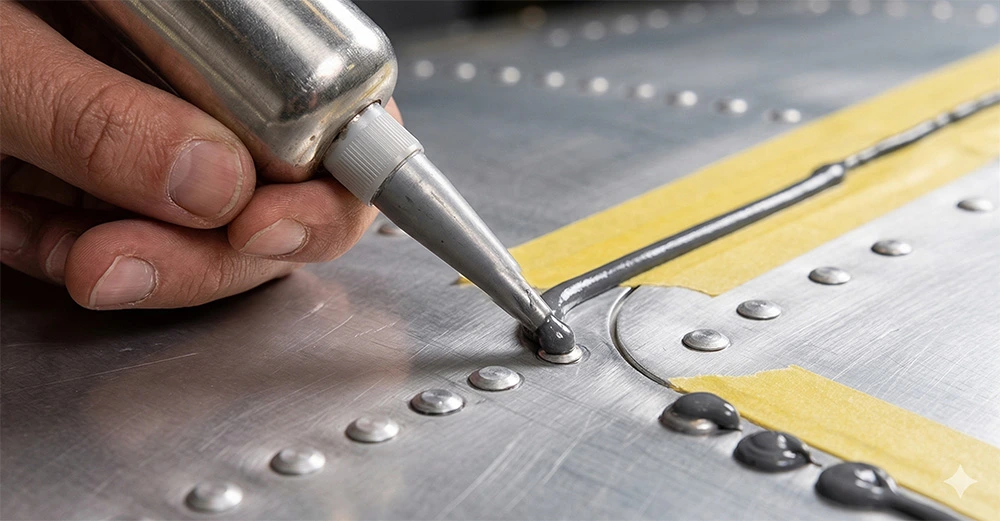
Operators go through specific training and certification. They learn not only the procedure, but also how to interpret it in real conditions. They develop the ability to control bead geometry, maintain continuity and adapt to different geometries and access constraints.
Because in the end, execution matters.
The pressure applied, the angle of the tool, the rhythm of application, even small decisions made in real time can influence the final result.
That is why, even today, a large part of this work remains manual. And in many cases, it becomes something very close to industrial craftsmanship, performed under extremely high quality standards.
The Process Everyone Relies On—But Few Talk About
Sealants are everywhere in an aircraft.
They are present between dissimilar materials, inside fuel tanks and across structural joints. They are essential to safety, durability and performance.
And yet, the application process itself does not always receive the level of attention it deserves.
Not because the materials are not excellent. They are.
Not because the industry lacks expertise. It does not.
But because the focus has traditionally been placed on the chemistry, while the application process remains less visible, even though it is just as critical.
ASA: Focused on the Process
At ASA , we focus on what truly makes the difference:
The application and processing of aeronautical sealants.
We design and manufacture in the heart of Europe advanced consumables and application systems, supporting leading aerospace companies such as Airbus, Lockheed Martin, Saab, Aernnova or Safran.
Because we believe something very simple:
The sealant can be excellent.
But without a controlled and repeatable process, its full value is never realized.
That is why we work on improving how it is applied. From patented encapsulation technologies that ensure correct mixing, to consumables designed to reduce variability, to close technical support working side by side with operators and production teams.
From Material Excellence to Process Excellence
Aerospace has achieved extraordinary levels in material science.
The next step is to give the same level of importance to how those materials are applied.
Sealant application is not just another step in the process. It is a critical, skill-driven discipline that directly impacts quality, efficiency and long-term performance.
And perhaps it is time to give it the visibility and recognition it truly deserves.